
A little bit of rain needed here…
Being a member of the local angling club allows me access to the various small lochs and streams that the club owns or leases. These waters hold Salmon, Sea-Trout, Trout, Pike, Perch and various other coarse fish. Not in any great abundance, I have to add. The potential reasons for this will be discussed in a separate post. I digress. A few weeks ago I had a rather fruitful day on one of these little spate rivers, where members tell me that catching one or two salmon in a season is considered a reasonable success. However unexpected it was to catch three salmon in a few hours fishing, it was the variety of fly and method of catching that was the most surprising.
The choice of fly is, and has always been, the worn out subject of many an angling journalist’s column. Here’s a little more wear and tear then.
There are a myriad of choices and methods; some more popular than others. It has been observed by the more agile minded that if a fly/method is popular, and more people are fishing with it, then it would then stand to reason that this fly is going to account for more fish than any other. To counter that argument, we can all relate to the generic anecdote: when nobody else was catching anything…blah;…tried something different…blah blah blah…lo and behold. Both are reasonable arguments to counter the other. However, it is not that simple. I mean, it is simple; it’s just not that type of simple. There are many factors that should influence the choice of fly: water temperature; river height; barometric pressure; size of river; water flow and water clarity. Some anglers will take into account all of these factors and more; some will focus on one or two; and some will just turn up at the river, revert to auto pilot and switch off. We will not bother with the choice of rod and fly line at this point as this too can be the subject of a future post.
Depending on my mood, I could be in either of these categories. On the association waters, I usually just fish till I, if fortune prevails, catch one salmon, or a brace or two of trout (depending on what I’m fishing for) and then go home satisfied. I seldom go home early. This particular time I was to be dropped off at the river and picked up at a pre-arranged time. This was due to some road works and, consequently, a dearth of available parking.
On arriving at the river, after making my way to the pool from the roadside, I was musing slightly about my predicament of having to stay at the river until the pre-arranged pick up time. How am I going to keep myself amused if the fishing is dour? I had left my camera at home and the supposedly breathable chest waders I was wearing put paid to any notion of wandering the hills and glens nature watching. At least not without sweating out all my body moisture and turning into a sucked out shell of dried up human carcass. Indeed, human jerky.
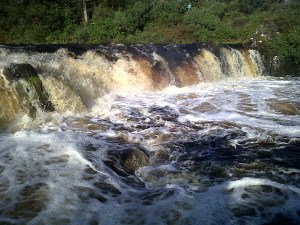
Falling nicely…
Despite my jaunty high spirited optimism at the potential fishless day ahead, the river was falling slowly and nicely. It was also running with a slight colour. Taking none of the usual factors into account, I went on gut instinct alone and chose a small black size 12 double shrimp type pattern black hair wing, black throat hackle, almost invisible yellow blue tail and a silver body. Oh yes, and the obligatory jungle cock ‘eyes’. I think it was called Bert’s Fancy or something. I crawled stealthily up to the pool and using a 10 foot single handled #7 with a floating line and a 12 foot leader, I threw the fly at the opposite bank and at the total mercy of a vicious upstream wind. On each and every cast, the upstream wind caught the light fly and spat it into every conceivable part of the river that I didn’t want it to land. It even contrived to blow it into the tall grass behind me after a back cast. Although, this was probably more to do with the back cast. Give me rain, snow or bright sunshine; even downstream wind is evil, but the upstream variety is the downstream wind’s demented and sadistic cousin. An exaggeration? I’m pretty sure that, sometimes, I can hear the wind whisper my name as it whistles through the flora laughing at my frustration and the superlatives uttering forth.
Nevertheless, the fly did, on occasion, land near to where I had intended it to. I accepted that it was always going to land slightly upstream of the main line and made adjustments by making an immediate slight upstream mend as the fly landed. I waited for the fly to sink and then pulled in a foot or so that the fly looked as though it had some life in it, rather than float aimlessly past the noses of the intended quarry. Ten minutes into this, the traverse of the fly suddenly stopped, ‘really!’ I thought. The slow tug-tug and subsequent tightening unleashed a bar of silver into the air and then off to sea. I disagreed with this course of action and tightened the drag to cement my point of view. The fish was not in the mood to surrender too easily but 5 minutes of toing and froing resulted in me having the last word. I photographed the 4lb grilse and returned it.
Due to its diminutive size, the pool would probably take a good while to settle. Happy enough with my day I decided on a little stroll. Nothing too strenuous, of course. About a couple of hundred yards downstream I was rewarded with a full view of an Osprey diving into the river to claim a decent sized fish of about 3-4lb. From behind a tree and through small binoculars, I watched it dismantle and consume the fish for 20 minutes or so. It was turning out to be a good day. Just to be clear, I like watching Ospreys, not the dismantling and consuming of fish.
I was still a couple of hours or so away from my pick up time so I decided to try the same pool again with the same fly. After several changes of fly in an hour, I had more or less decided that it was pointless. The river had also come down further. “One more fly and I’ll try something different this time”; this was how I was thinking. A number 6 treble Red Francis fell out of the box. I laughed at the thought of it but tied it on anyway. A dozen casts later, getting bored and pessimistic, I decided to whip it in fast through the pool. I picked up the line and stripped it quickly a foot or so at a time. The second strip produced a 6lb fresh run grilse. It was hooked deep down and had obviously intended to terminate the fly with extreme prejudice. This was great, but lucky perhaps.
After a quick phone call to confirm my pick up time and a further wait at the side of the river. I decided to put on an experimental fly that I had tied. I named it Red Envy and it was tied on a size 10 treble but I’m pretty sure it resembles some other fly. It was basically a red shrimp with a very short tail (I don’t trust long tailed flies – that’s another story) and some gold wire ribbing. That’s the trouble with my own self tied flies, they’re all experimental and they all resemble something that already exists. One of the reasons for that is I pay as much attention to the name or type of fly, as a salmon does. Needless to say, this fly accounted for the third fish – around the 7lb mark. Since there was less wind and a slightly heavier fly, it was easily fished in an orthodox downstream fashion but with a slight downstream mend to quicken its journey and, more importantly, give the salmon less chance to see it for what it was; a badly tied fly. Joking aside, I would be embarrassed to show this fly to another angler but, somehow, not to a salmon. Why is that?
So, rather than obsess over the choice of fly, get to the river, take a fly out of your box and attach it to your leader, then decide how you want to fish it. The salmon don’t really care as long as it intrigues them, angers them or upsets them enough for them to want to sort it out, so to speak. Get it in their face but not so much and not for so long a time that they recognise it for what it is.
Copyright © 2012
 wefishfly
I’ve just realized it’s a wordpress blog. Brilliant! I actual read it all. It’s quite a long wee story, or maybe it just seemed that way because some of the words are new to me. Nice photies!